Showing posts with label calligraphy alphabet. Show all posts

Friday, May 15, 2009

Calligraphy Strokes of Elegance

DNA: Lifestyle: Strokes of elegance
Mumbai: You've seen those beautifully handwritten scripts inscribed on stone monuments or in religious manuscripts written on palm leaves. Now see scripts come alive through calligraphy on T-shirts, CD covers, wedding cards, mugs, books, fashion wear and even as body art.

The aesthetics of calligraphy, i.e. the art of beautiful handwriting, has transcended into the commercial realm rather than being just confined to sophisticated use.

Achyut Palav, a celebrated city-based calligrapher and alumni of J.J. School of Art has a studio stocked with various products done in calligraphy. Ranging from mugs, glass items to T-shirts and books, the items are worth a buy. Palav is credited to having presented calligraphic prints in a fashion show, designing logos, body painting, home interiors, event invites, wallpapers and book covers etc. "Calligraphy can be done using different techniques and in different media. I have travelled all over India and have noticed that there still exists a lacuna in the execution and utility of calligraphy" he says, adding further that he has plans to open a calligraphy school very soon.

Says Santosh Kshirsagar, 49, professor at theJ.J. School of Art who has been in the field of calligraphy and typography for 20 years now, the key to popularising calligraphy lies in interacting with the youth and making them not only appreciate calligraphy but also motivate them to take up calligraphy in the indigenous Indian scripts. "Calligraphy is not just about acquiring the skill but it is equally about expressing yourself and adding your interpretation to the art work," he says.

Kshirsagar also insists that introduction of calligraphy at the school level is vital.
At present though, J.J. School of Art runs a four year degree course in Applied Art with specialisation in photography, typography and illustration among other subjects. Calligraphy is part of the typography course. Calligraphy artists feel the scope for students learning calligraphy nowadays is varied and well paying. Since the demand has grown and commercial requirements are manifold, a student can choose to be part of the professional world in areas like jewellery designing, body art, fashion, advertising and films and begin earning a minimum salary of Rs15,000.

While western calligraphy takes its root from the Roman alphabets, Chinese and Japanese calligraphy are still deeply entrenched in their day-to-day local tradition in the form of artefacts and gifts. Nepalese, Tibetan, Iranian calligraphy have also stood the test of the time. With 10 scripts existing in India, when it comes to Indian calligraphy, there is scope for a lot more work.

Read the rest of the Calligraphy Story


Tuesday, June 17, 2008

Chinese Calligraphy: HAPPINESS


An
old Chinese proverb says that a picture is worth a thousand words. My
recollection of the first time that I heard that adage is foggy. But,
I do recognize that I have heard it repeated many times in my lifetime.


It’s one of those sayings that fits with my psyche. For a long time
I have known that I am a visual person. That is my style of learning,
speaking and thinking.


The Chinese language in its written form is a system of pictures not
an alphabet. That makes for a complicated linguistic system that is
not easily mastered. Yet, it gives its written language an embedded art
form of calligraphy that is highly prized.


Culturally, the best educated have learned the discipline of
calligraphy. The product of putting ink on paper is an artform. It is
highly revered and beautifully symbolic as an expression of the culture.

You can read more of the story by Bruce Fong about chinese calligraphy


Thursday, April 3, 2008

Fun with the Alphabet

Two creative paths from A to Z. by Raymond Pirous|Fun with the Alphabet

Charles Roper thought I might like abcdefghijklmnopqrstuvwxyz, a short film directed by Roel Wouters, featuring the work of his son alongside that of his brother and calligrapher, Job Wouters in a live jam session juxtaposing the lettering art of the youthful amateur vs. that of the aged professional.


The image below is a compilation of both sets of the alphabet as drawn during the film:


abcdefghijklmnopqrstuvwxyz, a video by Job & Roel Wouters

Saturday, March 29, 2008

How Do You Spell “Publishing Excellence” in Japanese?


March 28, 2008 , and article by abbeville

maya.jpg arabic.jpg hiero1.jpg chinese-calligraphy.jpg

Better yet, here’s another question: how many publishers do you know whose catalog even has an Alphabets & Symbols division, never mind an expanding one?

Following in the footsteps of Abbeville’s popular Maya Script, Arabic Script, Hieroglyphics, and Chinese Calligraphy titles comes our latest volume about a non-Roman symbol system: Japanese Alphabet: The 48 Essential Characters. In this book, expert polyglot Gabriel Mandel (author of Arabic Script) guides the reader through all 48 principal Japanese characters and their associated sounds, providing the roma-ji, or Roman phonetic spelling, for each. Also included are diagrams that demonstrate how to reproduce each character stroke by stroke, leaving you, the reader, just one fancy calligraphy pen away from writing in one of the world’s most elegant languages. If you’ve already bought the four volumes mentioned, you can even try combining all five ancient languages into one truly impenetrable secret codeor one hell of a party trick (”Any ancient Maya in the room?”).

You can read more of the article at The Abbeville Manual of Style

Wednesday, December 5, 2007

Can the Use of the Calligraphy Alphabet Improve Your Creativity?


We all know that Steve Jobs is the world’s second most successful college dropout. (Bill Gates, of course, is the world’s biggest failure).

But here’s something you didn’t know. After Jobs dropped out of Reed College, he went back to school as a drop-in and studied a subject that turned out to be vital to the development of the computer as we know it…

He took a course in calligraphy.

It’s hard to believe but according to a commencement address Jobs gave at Stanford University in 2005:

It was beautiful, historical, artistically subtle in a way that science can’t capture, and I found it fascinating….

If I had never dropped in on that single course in college, the Mac would have never had multiple typefaces or proportionally spaced fonts. And since Windows just copied the Mac, its likely that no personal computer would have them.

So there you have it. Whether you’re using a Mac or a PC, your computer owes everything to Steve Jobs’ understanding of the intricacies of sans serif.

The Creativity of Calligraphy
But we started to wonder what else a crash course in the art of writing might have done for Steve Jobs. Did all those curlicues and italics spark Jobs’ creative juices, get his ideas flowing and lead him to build a company that owes as much to the appearance of the gadgetry as the whiz-bang programming under the hood?

And what could it do for anyone? Could it help you to create a tech company as stylish as Apple?

Maybe, says Alok Hsu Kwang-han, a Chinese artist who specializes in creating calligraphic art, but it depends on you. He told us:

Practicing anything, including calligraphy, can enhance one’s creativity or it can reinforce an old rut and mindset! It all depends on whether you bring to the practice a willingness to be playful, to be fully present without expectations, to experiment without judgment, and to thoroughly enjoy yourself! The truly original creativity cannot be practiced…

I think Steve Jobs by dropping out of college and dropping into what he loved to explore, brought these qualities to his enjoyment of calligraphy at Reed College.

That potential to release creativity (rather than create it) is particularly true of Chinese calligraphy, adds Alok. Its technique allows the brush to move vertically as well as horizontally, and calls “the calligrapher to be very present and available to the possibilities offered in each moment of the movement. It offers an alertness and a letting-go that promotes creativity.”

Zen and the Art of the iPod
That’s all very nice but Steve Jobs was practicing western calligraphy rather than the sort of Asian brushwork that involves turning complex characters into flowing artworks. He was also talking specifically about the benefit of having a variety of fonts available on computers rather than releasing his own hidden creative talents.

And yet if you compare the sort of minimalist images produced by Alok Hsu Kwang-han with the stark style of the iPod with its white space and hidden buttons, you can’t help but feel that maybe there’s something to it. Even if Jobs spent his time learning Times New Roman and letter spacing rather than shufa and the thickness of xuan paper, could his being in the moment — while being in that calligraphy class at Reed College — have helped him to appreciate the value of having nothing but a click-wheel on the front of an all-white media player?

More importantly, could the creativity of calligraphy — and the sense of just letting go that comes with any successful endeavor — do the same for you?

Well, maybe not with calligraphy and maybe not with Asian calligraphy in particular. According to Alok, it doesn’t really matter what the practice or art form is; it’s the fit and the result that matters:

[It] depends on who the person is. Dance, theater, song writing, drumming, to name a few, are also good ways. I have discovered that calligraphy is a very good way for those attracted to engaging themselves in it. As Chuang Tzu says, “If the shoe fits, wear it.”

You can read the rest of the story of How Calligraphy can Improve Your creativity

Wednesday, September 5, 2007

The Western Use Of The Calligraphy Alphabet

Western Calligraphy

The Calligraphy Alphabet is used throughout the world in many cultures. This article describes some of the uses in the western world. Main article: Western calligraphy The Historical evolution of Western calligraphy[1]


Western Calligraphy

Calligraphy is recognizable by the use of the Roman alphabet. The alphabet came from the Phoenician, Greek, and Etruscan alphabets. The first Roman alphabet appeared about 600 BC, in Rome. About the first century we can see Roman square capitals carved on stones, Rustic capitals painted on walls, and Roman cursive for daily use. This trend continued into the second and third centuries using the Uncial, however writing withdrew to monasteries and was preserved there during the fourth and fifth centuries, when Roman Empire finally fell and Europe entered the Dark Ages.

At the height of the Roman Empire its power reached as far as Great Britain, when the empire fell, its literary influence remained. The Semi-uncial generated the Irish Semi-uncial, the small Anglo-Saxon. In fact, each region seemed to have develop its own standards following the main monastery of the region (i.e. Merovingian script, Laon script, Luxeuil script, Visigothic script, Beneventan script) which are mostly cursive and hardly readable.

The raising of the Carolingian Empire encouraged to set a new standardized script, developed by several famous monasteries (Corbie Abbey, Beauvais,...) around the eighth century, it's finally the script from Saint Martin de Tours which is set as the new Imperial standard, named the Carolingian script (or "the Caroline"). From the Carolingian powerful Empire, this standard also conquered neighbouring kingdoms.

Summary: The use of the Calligraphy Alphabet in the Western World has developed from many styles and forms descending from the ancient art of "beautiful writing".


Method of holding the brush when using the Calligraphy Alphabet


The Chinese method of holding the brush

There are various styles and techniques used to hold the brush when used to develop one’s use of the calligraphy alphabet for artful writing. I have provided a brief description in the following paragraphs of two different genres or cultures.

How the brush is held depends on which calligraphic genre is practiced. For Chinese calligraphy, the method of holding the brush is more special; the brush is held vertically straight gripped between the thumb and middle finger. The index finger lightly touches the upper part of the shaft of the brush (stabilizing it) while the ring and little fingers tuck under the bottom of the shaft. The palm is hollow and you should be able to hold an egg in there. This method, although difficult to hold correctly for the beginner, allows greater freedom of movement, control and execution of strokes. For Japanese calligraphy, the brush is held in the right hand between the thumb and the index finger, very much like a Western pen.

A paperweight is placed at the top of all but the largest pages to prevent slipping; for smaller pieces the left hand is also placed at the bottom of the page for support.

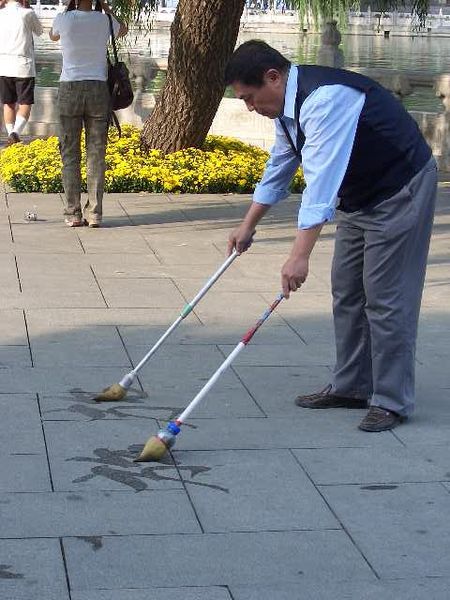
In China, there are many people who practice calligraphy in public places such as parks and sidewalks, using water as their ink and the ground as their paper. These skillful artists use very large brushes with this technique. Although such calligraphic work using the calligraphy alphabet is temporary, they serve the dual purpose of both being an informal public display of one's work, and an opportunity to further practice one's calligraphy.